blackjack split and double after split
Blackjack is one of the most recognizable casino card games, combining simple rules with decisions that influence the outcome of each hand. While hitting and standing are familiar actions, experienced players also pay attention to two important options: splitting pairs and doubling after a split.
These moves allow players to change the structure of their hands and adjust their wagers during a round. However, they also introduce additional financial risk and require an understanding of the game’s rules.
In this guide, we’ll explain what splitting means in blackjack, how the double after split (DAS) rule works, and why these options matter when choosing a blackjack table.
What Is a Split in Blackjack?
A split is a blackjack action that allows a player to divide two cards of equal value into two separate hands.
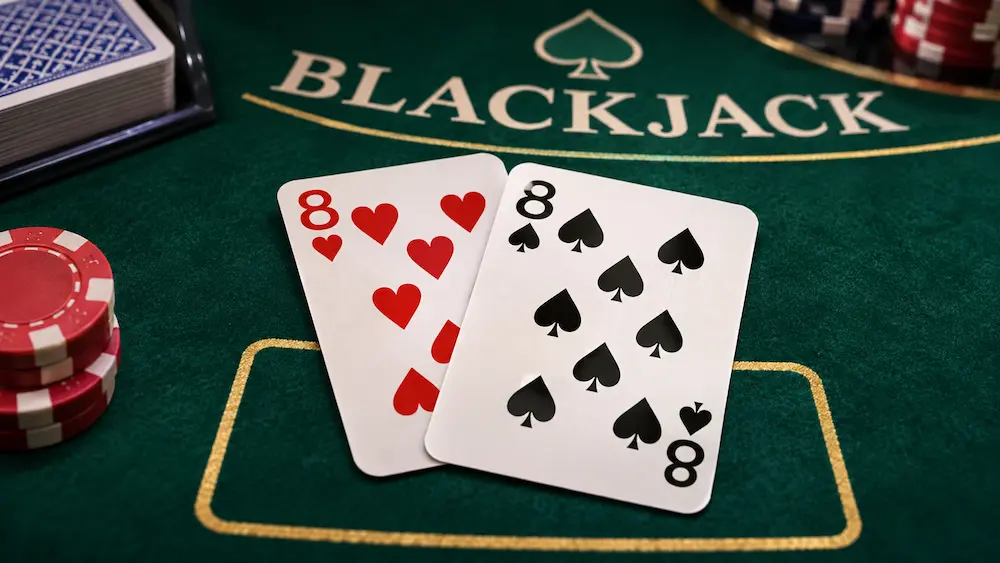
For example, imagine receiving two 8s. Together, these cards form a total of 16, which is generally a difficult starting hand.
Instead of playing both cards together, you can choose to split them.
The dealer separates the cards and deals an additional card to each new hand. You then play the two hands independently.
To complete the split, you must place an additional wager equal to your original bet.
Example of Splitting a Pair
Suppose you begin a blackjack round with a €10 wager.
Your first two cards are:
8 of Hearts
8 of Spades
You decide to split.
You now have two separate hands, each carrying a €10 wager. Your total amount at risk increases to €20.
Each hand receives another card, and you can make further decisions according to the rules of the game.
Splitting does not guarantee a better outcome. Both hands may win, both may lose, or they may produce different results.
What Is Double After Split in Blackjack?
Double after split (DAS) is a blackjack rule that allows players to double down on a hand created by splitting a pair.
Normally, doubling down means increasing the wager on a two-card hand, typically by an amount equal to the original bet, in exchange for receiving exactly one additional card.
When a blackjack table permits DAS, this option remains available on eligible hands after a split.
How Does Split Double Work?
Imagine the following situation:
You place a €10 blackjack bet.
You receive two 8s and split them.
Your total wager becomes €20.
The first 8 receives a 3, creating a total of 11.
You choose to double down on that hand.
You add another €10 and receive one final card.
Your total amount at risk is now €30 across two hands.
If you also double the second split hand, your combined wager could reach €40.
This example highlights an important characteristic of DAS: it creates additional betting opportunities, but also increases potential losses.
Split vs. Double After Split: Key Differences
Although these actions are related, they serve different purposes.
| Feature | Split | Double After Split |
|---|---|---|
| Main purpose | Create two separate hands | Increase the wager on a split hand |
| Requirement | Two starting cards of equal value | An eligible hand created by splitting |
| Additional wager | Equal to original bet | Usually equal to the wager on that hand |
| Cards received | New cards for each hand | Exactly one final card |
| Availability | Depends on table rules | Only when DAS is permitted |
Understanding the distinction helps players avoid confusing these actions with standard doubling down.
When Should You Split in Blackjack?
The decision to split depends on your cards, the dealer’s visible card, and the rules of the blackjack variation.
Basic blackjack strategy uses mathematical probabilities to identify decisions that generally produce the best expected outcome.
Some common examples include:
Splitting Aces
A pair of Aces can be worth either 2 or 12, depending on how the hand is counted. Splitting creates two opportunities to build strong hands. However, many blackjack games allow only one additional card per split Ace.
Splitting 8s
Two 8s create a hard 16, one of the most challenging blackjack totals. Splitting is generally the recommended basic strategy action, although the expected outcome still depends on the dealer’s card and specific game rules.
Keeping 10s Together
A pair of 10-value cards produces a total of 20, which is already a strong hand. Standard basic strategy generally recommends standing rather than splitting.
Avoiding a Split of 5s
Two 5s create a total of 10. This hand often offers better opportunities through hitting or doubling than through splitting.
These guidelines are general examples. A complete basic strategy chart should always match the table’s particular rules.
When Is Double After Split Useful?
DAS becomes relevant when a player receives a favorable total after separating a pair.
Consider splitting two 4s against a dealer showing 6, in a game where the strategy chart recommends this action.
After splitting, one of your 4s receives a 7.
You now have a total of 11.
If DAS is available, you may double down, adding another wager before receiving your final card.
Without DAS, doubling would not be permitted on this split hand.
The option can improve the expected value of certain decisions because it allows players to increase their stake in mathematically favorable situations.
However, having the option does not mean doubling every eligible hand is advisable.
How Does DAS Affect Blackjack Strategy?
The availability of double after split can influence which pairs should be separated in the first place.
For example, depending on the number of decks and other rules, some basic strategy charts recommend splitting pairs of 2s, 3s, or 4s in situations where DAS is permitted but recommend a different action without DAS.
This happens because the opportunity to double later changes the expected value of the original split.
Does DAS Reduce the House Edge?
All else being equal, a DAS rule generally benefits players who follow appropriate basic strategy.
It can slightly reduce the house edge compared with an otherwise identical blackjack game that prohibits doubling after splitting.
Nevertheless, blackjack remains a casino game with a mathematical house advantage under conventional rules.
DAS does not eliminate that advantage or guarantee profitable play.
Important Blackjack Splitting Rules
Before attempting a split or split double, players should understand the restrictions that may apply.
1. Maximum Number of Splits
Some blackjack games allow players to split multiple times, while others limit the number of hands that can be created.
2. Restrictions on Splitting Aces
Many tables permit only one additional card for each split Ace. Doubling after splitting Aces is also commonly prohibited.
3. Resplitting Pairs
Some variations allow another split if a new hand receives a matching card. Other games do not.
4. Blackjack After Splitting
Receiving an Ace and a 10-value card after a split generally counts as an ordinary 21 rather than a natural blackjack. It normally pays even money rather than the blackjack premium.
5. Double After Split Availability
Not every blackjack variation supports DAS. Some games allow doubling only on the original two-card hand.
For example, published rules for certain NetEnt blackjack games allow doubling after a split but exclude split Aces.
cdn-sp.kertn.net+1
Always review the game information before placing a wager.
Common Mistakes When Splitting and Doubling
One frequent mistake is splitting every pair without considering the dealer’s upcard.
Another is doubling after a split simply because the option is available.
Players may also underestimate how quickly additional bets accumulate during a single round.
For example, a €10 starting bet can become €40 when two hands are created and both are doubled.
A sensible approach involves understanding the rules, consulting an appropriate basic strategy chart, and establishing a fixed entertainment budget.
Neither splitting nor doubling changes the randomness of the cards.
Can You Use Split and DAS in Online Blackjack?
Online blackjack games generally display available decisions through interactive controls.
Depending on the game, players may see buttons such as Hit, Stand, Split, and Double.
When a pair is eligible for splitting, the Split option becomes available. After the split, the Double button may appear on eligible hands if the game supports DAS.
At WildTornado Casino, players can explore the casino’s available games and review the individual rules of supported blackjack titles.
Different blackjack games may have different restrictions, betting limits, and payout structures, so checking the information panel is essential.
Is Split Double a Winning Blackjack Strategy?
Split double is not a standalone system that guarantees success.
It is a combination of two ordinary blackjack decisions: separating a pair and doubling an eligible resulting hand.
Both actions can be part of mathematically informed play, but their usefulness depends on the specific situation.
Even a correctly executed decision can result in a loss.
The objective of basic strategy is to minimize the expected house advantage, not to predict cards or ensure winning rounds.
Conclusion
Understanding split and double after split in blackjack helps players make more informed decisions at the table.
Splitting creates two independent hands from a matching pair, while DAS allows an eligible split hand to be doubled before receiving one final card.
These options can change the expected value of certain decisions, but they also increase the amount wagered.
Whether you’re learning blackjack fundamentals or exploring different card game variations, reviewing the table rules and understanding each action are essential parts of the experience.
Explore the available casino games at WildTornado and discover how different blackjack rules shape gameplay.
Play responsibly. Casino games involve financial risk, and no strategy guarantees a win. Set limits and play only where legally permitted.
Frequently Asked Questions About Blackjack Splitting
What does split mean in blackjack?
A split allows a player to separate two starting cards
of equal value into two independent hands. Each hand
requires its own wager and is played separately.
What is double after split in blackjack?
Double after split (DAS) is a rule that allows players
to double down on eligible hands created by splitting
a pair. After doubling, the player receives exactly
one additional card for that hand.
Can you double down after splitting Aces?
Most blackjack variations do not permit doubling
after splitting Aces. Players are commonly limited
to one additional card per split Ace, although
exact restrictions depend on the game rules.
Should you always split 8s in blackjack?
Splitting 8s is generally recommended by standard
blackjack basic strategy because a hard 16 is a
difficult starting hand. However, the best decision
can depend on the dealer’s upcard and table rules.
Does double after split improve your odds?
Allowing double after split can slightly reduce
the house edge when players follow appropriate
basic strategy. It does not guarantee a win
or eliminate the casino’s mathematical advantage.
Do all online blackjack games allow DAS?
No. Double after split is available in some blackjack
variations but restricted in others. Players should
check the game’s rules before starting a round.
Author

 I am the Director of a company that specializes in providing a range of services including marketing analytics, web design, email marketing, content creation, and graphic design. With over 13 years of experience in analytics and marketing, I have successfully managed teams and developed strategies that cater to various client needs. My role involves overseeing projects, ensuring quality service delivery, and driving business growth through effective marketing solutions.

 I am the Director of a company that specializes in providing a range of services including marketing analytics, web design, email marketing, content creation, and graphic design. With over 13 years of experience in analytics and marketing, I have successfully managed teams and developed strategies that cater to various client needs. My role involves overseeing projects, ensuring quality service delivery, and driving business growth through effective marketing solutions.