chasing losses in gambling
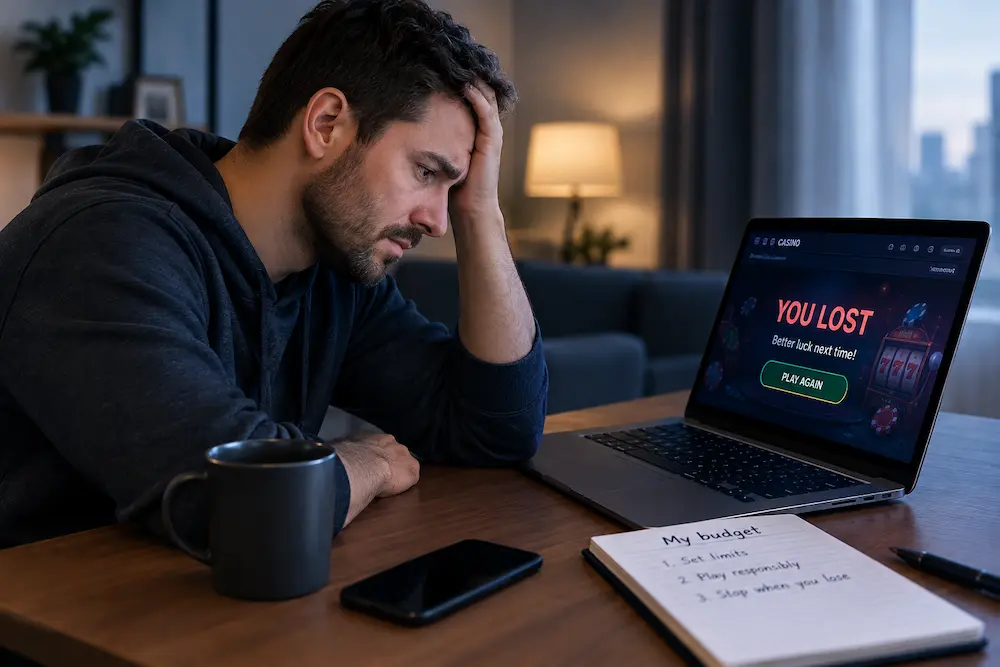
Losing money is a possible outcome of every casino session. Whether you enjoy online slots, roulette, blackjack, or other casino games, the results will not always go your way. However, one of the most dangerous reactions to a losing session is trying to win your money back immediately.
This behaviour is known as chasing losses in gambling, and it can quickly turn a manageable loss into a much larger financial problem.
At WildTornado Casino, we believe understanding gambling risks is an essential part of responsible entertainment. In this guide, we explain why chasing losses is dangerous, how it affects decision-making, and what you can do to maintain control over your gambling habits.
What Does Chasing Losses Mean in Gambling?
Chasing losses happens when a player continues gambling, increases their bets, or deposits additional money specifically to recover funds they have already lost.
For example, imagine someone starts playing online slots with a budget of €50. After losing that amount, they deposit another €100 because they believe a winning spin is coming. If that money disappears too, they may feel pressured to continue playing until they return to their original balance.
The problem is that every additional wager introduces another risk of losing money.
Common examples of chasing losses include:
Increasing bet sizes after several unsuccessful spins.
Making additional deposits beyond the original gambling budget.
Switching to higher-risk games in search of bigger payouts.
Continuing to play despite feeling frustrated or stressed.
Borrowing money to recover previous gambling losses.
Refusing to end a session until reaching a previous balance.
Chasing losses is not a gambling strategy. It is a behavioural response that can lead to increasingly risky decisions.
Why Do Players Try to Recover Their Losses?
Several psychological factors explain why players may feel compelled to continue gambling after losing money.
1. Loss Aversion
People generally experience the emotional impact of losing money more strongly than the satisfaction of gaining an equivalent amount.
For example, losing €100 may feel more upsetting than winning €100 feels rewarding.
This emotional imbalance can encourage players to take unnecessary risks to avoid accepting a loss.
2. The Gambler’s Fallacy
The gambler’s fallacy is the mistaken belief that previous random outcomes influence future independent outcomes.
A player who experiences ten losing roulette spins might believe the next spin is more likely to produce a win.
However, in a fair roulette game, previous results do not change the probability of the next independent spin.
The same principle applies to properly functioning RNG-based online slots.
3. Emotional Decision-Making
Frustration, disappointment, and anxiety can interfere with rational decision-making.
Instead of following a predetermined budget, a player may increase their bets impulsively.
The more emotionally involved someone becomes, the harder it may be to recognise when it is time to stop.
4. The Illusion of Control
Some players believe they can influence random casino outcomes through timing, betting patterns, or personal rituals.
Although certain games involve strategic choices, no betting system can guarantee recovery of previous losses or eliminate the house edge.
Why Is Chasing Casino Losses Dangerous?
The primary danger of chasing losses is that it turns an already completed loss into a reason to risk additional money.
Financial Consequences
Repeated deposits and larger wagers can quickly exhaust a player’s gambling budget.
What begins as an attempt to recover €20 may eventually lead to losses of several hundred euros.
If the player continues using money intended for essential expenses, the consequences can become particularly serious.
Escalating Risk
Players chasing losses often increase their betting amounts to compensate for previous unsuccessful wagers.
Larger bets create the possibility of larger individual losses, potentially accelerating the depletion of available funds.
Emotional Stress
Repeated losing sessions can cause frustration, anxiety, guilt, or difficulty concentrating.
These feelings may encourage further gambling, creating a cycle that becomes increasingly difficult to interrupt.
Loss of Financial Control
When gambling decisions are driven by the need to recover money, players may stop following their usual spending limits.
This can lead to repeated deposits, neglected responsibilities, and financial difficulties.
Why Increasing Your Bets Does Not Guarantee Recovery
One of the most common misconceptions about gambling is that increasing bet sizes after losses improves the chance of eventually making a profit.
Consider a simplified example involving an even-money roulette bet.
| Round | Bet Amount | Result | Total Loss |
|---|---|---|---|
| 1 | €10 | Loss | €10 |
| 2 | €20 | Loss | €30 |
| 3 | €40 | Loss | €70 |
| 4 | €80 | Loss | €150 |
| 5 | €160 | Loss | €310 |
After five consecutive losses, the player has lost €310 despite beginning with a €10 wager.
This illustrates a weakness of the Martingale betting system, which relies on doubling the bet after each loss.
Even-money roulette bets are not true 50/50 propositions because of the zero pocket, or zero and double-zero pockets, depending on the roulette variant.
In European roulette, the probability of winning a single red-or-black wager is approximately 48.65%.
Increasing the amount wagered does not improve that probability.
Furthermore, casino table limits and personal bankroll restrictions make unlimited bet doubling impossible.
No betting progression can guarantee that lost money will be recovered.
How the House Edge Affects Gambling Losses
Every casino game has mathematical rules that determine its probabilities and expected returns.
The house edge represents the casino’s statistical advantage over players over a large number of wagers.
For example:
| Casino Game | Typical House Edge |
|---|---|
| European Roulette | 2.70% |
| American Roulette | 5.26% |
| Blackjack | Around 0.5% with favourable rules and optimal basic strategy |
| Online Slots | Varies by game and RTP |
For slots, a game with a theoretical return to player (RTP) of 96% has a corresponding theoretical house edge of 4%.
This does not mean that a player will lose exactly €4 for every €100 wagered during an individual session.
Short-term results can vary significantly due to randomness and volatility.
However, playing longer and wagering more money generally increases expected losses when the game has a house edge.
This is another reason why continuing to gamble specifically to recover money can be financially harmful.
How to Stop Chasing Losses in Online Casinos
Developing responsible gambling habits can reduce the likelihood of emotional and impulsive decisions.
Set a Gambling Budget
Before starting a session, decide how much money you can comfortably afford to lose.
This amount should come exclusively from discretionary entertainment funds, never from money needed for rent, groceries, bills, or savings goals.
Once that budget is exhausted, stop playing.
Establish a Loss Limit
A loss limit defines the maximum amount you are willing to lose during a particular period.
For example, if your weekly entertainment budget is €50, you should not increase it simply because a session ended unsuccessfully.
Avoid Emotional Gambling
Playing while angry, upset, anxious, or under significant financial pressure increases the likelihood of impulsive decisions.
Taking a break can help prevent these emotions from influencing gambling behaviour.
Use Responsible Gambling Tools
Depending on the operator and account settings, responsible gambling features may include deposit limits, loss limits, session reminders, cooling-off periods, and self-exclusion.
These tools can help players establish boundaries or restrict gambling access.
Never Borrow Money to Gamble
Borrowing money, using credit intended for essential expenses, or taking out loans to recover gambling losses significantly increases financial risk.
Gambling should never be treated as a way to solve financial problems.
Warning Signs That Gambling Is Becoming a Problem
Chasing losses can sometimes indicate a developing gambling-related problem, particularly when it becomes repetitive or difficult to control.
Potential warning signs include:
Thinking constantly about recovering money lost in previous sessions.
Gambling with larger amounts than originally intended.
Hiding gambling expenses from family or friends.
Feeling unable to stop after losing.
Using money intended for essential living expenses.
Experiencing stress or sleep problems related to gambling.
Continuing to gamble despite negative financial consequences.
Recognising these behaviours early can help prevent more serious difficulties.
If gambling is causing harm, consider stopping and seeking assistance from qualified support services. Self-exclusion and professional guidance may be appropriate when setting personal limits is no longer effective.
What Should You Do After Losing Money at an Online Casino?
The healthiest response to a losing session is to accept that the money has been spent on entertainment and avoid placing additional wagers to recover it.
A practical approach involves ending the session, checking your spending against your predetermined budget, and taking time away from gambling.
If the loss creates financial pressure, prioritise essential expenses and consider seeking financial or gambling-support advice instead of returning to the casino.
It is also important to understand that a previous loss does not create an opportunity for a guaranteed future win.
Each independent game outcome remains uncertain, regardless of the results that came before it.
Responsible Gambling at WildTornado Casino
At WildTornado Casino, gambling should be approached as a form of entertainment rather than a source of income or a financial recovery method.
Understanding RTP, volatility, game probabilities, and gambling-related psychological risks can help players make more informed decisions.
Before playing, it is important to establish a realistic entertainment budget, understand the rules of the selected games, and recognise personal limits.
When gambling stops being enjoyable or begins affecting financial stability and emotional well-being, taking a break or stopping entirely is the appropriate choice.
Players who need support can explore independent resources such as GambleAware or GamCare, subject to their location.
Conclusion: Why You Should Never Chase Gambling Losses
Chasing losses is dangerous because it encourages players to make increasingly risky financial decisions based on emotional reactions rather than realistic probabilities.
No casino game, betting system, or sequence of wagers guarantees that previously lost money can be recovered.
The most effective way to avoid chasing losses is to establish clear financial boundaries, understand how casino games work, and stop gambling when those boundaries are reached.
Remember: gambling should remain entertainment, not an attempt to recover money or generate income.
Frequently Asked Questions
What does chasing losses mean in gambling?
Chasing losses means continuing to gamble, increasing
bets, or depositing more money specifically to recover
previous gambling losses. This behaviour can increase
financial risks and contribute to problematic gambling.
Why is chasing losses dangerous?
Chasing losses is dangerous because it encourages
emotional decisions, larger wagers, and additional
financial risks. Continuing to gamble does not
guarantee that previously lost money will be recovered.
Can you recover gambling losses by increasing bets?
Increasing bet sizes does not guarantee recovery of
gambling losses. Betting systems such as Martingale
cannot eliminate the house edge, and larger wagers
can lead to significantly greater financial losses.
How can I stop chasing casino losses?
Set a gambling budget, establish strict loss limits,
avoid gambling while emotional, and stop playing
when your budget is exhausted. Consider using
responsible gambling tools or seeking professional
support if stopping becomes difficult.
Does playing longer increase the chance of winning back losses?
Playing longer does not guarantee recovery of
previous losses. Casino games generally have a
mathematical house edge, meaning additional wagering
increases expected losses over time, even though
individual results remain unpredictable.
Is chasing losses a sign of gambling addiction?
Repeatedly chasing losses can be a warning sign of
problem gambling, particularly when accompanied by
financial difficulties, emotional distress, or an
inability to stop. However, this behaviour alone
does not establish a clinical diagnosis.
What should I do after losing money at an online casino?
Stop gambling, avoid making additional deposits,
and review your spending against your original
entertainment budget. If gambling losses are
affecting your finances or well-being, seek
assistance from a qualified support service.
Author

 I am the Director of a company that specializes in providing a range of services including marketing analytics, web design, email marketing, content creation, and graphic design. With over 13 years of experience in analytics and marketing, I have successfully managed teams and developed strategies that cater to various client needs. My role involves overseeing projects, ensuring quality service delivery, and driving business growth through effective marketing solutions.

 I am the Director of a company that specializes in providing a range of services including marketing analytics, web design, email marketing, content creation, and graphic design. With over 13 years of experience in analytics and marketing, I have successfully managed teams and developed strategies that cater to various client needs. My role involves overseeing projects, ensuring quality service delivery, and driving business growth through effective marketing solutions.