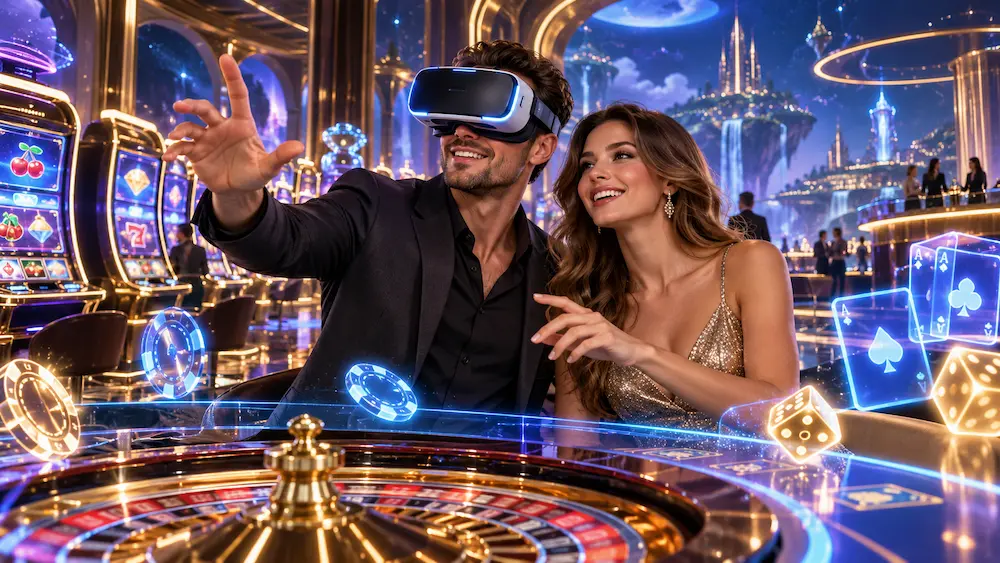
virtual reality casinos
The online casino industry has evolved dramatically over the past two decades. What started as simple digital versions of traditional casino games has developed into an interactive entertainment experience featuring live dealers, mobile gaming, advanced graphics, and personalized features.
Now, another technology could reshape the industry: virtual reality (VR).
Imagine entering a luxurious casino without leaving your living room. Instead of clicking buttons on a flat screen, you could walk through a virtual gaming floor, approach a blackjack table, interact with other players, and explore an entirely digital environment.
Virtual reality casinos could make these experiences possible. Although the technology is still developing, its potential applications extend far beyond visual improvements.
In this article, we explore how VR technology works, how it could transform online gambling, and what challenges the industry must overcome before immersive casinos become widely accessible.
What Is Virtual Reality in Online Casinos?
Virtual reality is a technology that creates computer-generated three-dimensional environments that users can explore and interact with.
Unlike conventional online casino platforms, which display games on smartphones or computer screens, VR environments aim to create a sense of physical presence inside a digital space.
Players typically access virtual reality through specialized headsets equipped with motion-tracking technology.
These devices can detect head movements and adjust the visual environment accordingly.
Some systems also support hand tracking or controllers, allowing users to interact with virtual objects.
How Does a VR Casino Work?
A virtual reality casino could operate as a digital building containing different gaming areas.
After putting on a compatible headset, a player might enter a virtual lobby and navigate between gaming rooms.
Potential features include:
Three-dimensional casino interiors with realistic lighting and sound.
Interactive slot machines and table games.
Virtual avatars representing other players.
Digital dealers or simulated casino staff.
Multiplayer gaming rooms and social spaces.
Customizable environments and interactive objects.
Instead of navigating traditional menus, users could interact with games as though they were visiting a physical casino.
However, VR presentation does not automatically change how a casino game determines outcomes. Random number generators and other game systems would still need to function according to applicable technical and regulatory requirements.
How Could Virtual Reality Transform the Casino Experience?
Virtual reality has the potential to introduce several changes to online casino entertainment.
1. More Immersive Gaming Environments
One of the most significant advantages of virtual reality is immersion.
Traditional online casinos depend on two-dimensional interfaces, animations, and sound effects to create an engaging atmosphere.
VR could expand these features into fully interactive environments.
For example, players might explore a digital casino inspired by Las Vegas, enter a futuristic gaming station, or visit a themed room designed around a particular slot game.
Environmental details such as spatial audio, animated decorations, and realistic lighting could make these spaces feel more convincing.
The result would be a different form of interaction rather than simply an improved version of existing casino graphics.
2. Interactive Live Dealer Games
Live dealer games already connect online players with real dealers through video streaming.
Virtual reality could introduce additional ways to experience these games.
Instead of watching a dealer through a standard video window, players could enter a simulated casino room containing a virtual representation of the gaming table.
A VR live casino could potentially combine:
Real-time video streaming.
Three-dimensional table environments.
Spatial audio communication.
Interactive seating positions.
Hand-tracking controls.
Multiplayer interaction.
Players might be able to look around the table, observe other participants’ avatars, and interact with selected virtual elements.
Such systems would require careful synchronization between real-world video feeds and virtual environments.
3. Social Interaction Between Players
Traditional online casinos are primarily individual experiences.
Even when multiplayer features are available, communication often takes place through text chat or limited interactive tools.
Virtual reality could introduce stronger social elements.
Users might create personalized avatars, enter shared gaming rooms, and communicate through voice chat.
For example, a group of friends living in different countries could potentially meet inside the same virtual casino environment.
They could explore gaming areas together or participate in compatible multiplayer activities.
These social experiences could make virtual casinos resemble digital entertainment venues rather than conventional gambling websites.
Privacy controls, moderation tools, and player safety features would be especially important in these shared environments.
Could VR Change Online Slot Games?
Slot machines are among the most recognizable features of online casinos.
Modern online slots already include animated symbols, themed environments, interactive features, and advanced visual effects.
Virtual reality could expand these elements into three-dimensional experiences.
Exploring 3D Slot Environments
Instead of displaying reels in a traditional rectangular interface, a VR slot could place the game inside a themed virtual world.
Imagine exploring an ancient temple, a futuristic city, or a fantasy castle while interacting with game elements.
The reels could appear as part of the environment, while animations and environmental effects create an additional layer of presentation.
These features would primarily change the visual and interactive experience.
They would not necessarily alter the mathematical mechanics of the slot.
New Ways to Interact With Games
VR could also introduce alternative controls.
Players might use hand gestures to select games, access information, or activate permitted gameplay functions.
Motion tracking could make navigation more intuitive in certain environments.
However, developers would need to ensure that accessibility, usability, and comfort remain priorities.
Traditional controls should remain available where practical, particularly for users who cannot comfortably operate motion-based interfaces.
Virtual Reality vs Traditional Online Casinos
Although VR casinos offer interesting possibilities, conventional online casino platforms remain more accessible.
The differences become clearer when comparing the two formats.
| Feature | Traditional Online Casino | Potential VR Casino |
|---|---|---|
| Interface | 2D website or mobile app | Immersive 3D environment |
| Equipment | Smartphone, tablet, or computer | Compatible VR headset |
| Navigation | Touchscreen, mouse, keyboard | Motion controls, hand tracking |
| Social interaction | Chat and selected multiplayer features | Avatars, voice chat, shared spaces |
| Graphics | 2D and 3D screen-based visuals | Stereoscopic virtual environments |
| Accessibility | Broad device compatibility | Limited by hardware and comfort |
| Development costs | Established infrastructure | Additional VR development requirements |
Virtual reality offers a different level of immersion, but it also introduces technical and practical limitations.
For many users, traditional mobile and desktop casino platforms may continue to offer greater convenience.
How Could Artificial Intelligence Improve VR Casinos?
Artificial intelligence could play an important role in the development of virtual casino environments.
AI-powered systems might support dynamic game interfaces, automated assistance, and more natural interactions with digital characters.
Intelligent Virtual Assistants
Future VR casinos could feature virtual assistants capable of answering questions about navigation, game rules, or account settings.
Instead of opening a support window, users might communicate with an AI-powered character inside the virtual environment.
These assistants could provide information through spoken responses or interactive menus.
However, account-sensitive actions would still require appropriate security checks and human oversight where necessary.
Personalized Virtual Environments
AI could potentially help users customize the appearance of virtual casino spaces.
For example, players might choose preferred visual themes, accessibility settings, or simplified navigation layouts.
Responsible personalization should prioritize user control and privacy rather than encouraging excessive gambling.
Improved Security Monitoring
AI systems could also assist with detecting unusual account activity or identifying potential security risks.
In VR environments, additional interaction data may create new security considerations.
Operators would need clear policies describing what information is collected, why it is necessary, and how it is protected.
What Challenges Could Prevent VR Casinos From Becoming Mainstream?
Despite its potential, virtual reality faces several obstacles.
Expensive Hardware
One of the largest barriers is the cost of VR equipment.
While traditional online casinos can operate on devices users already own, immersive gaming generally requires additional hardware.
The expense may discourage casual users from adopting VR casino platforms.
Technical Performance Requirements
Immersive environments require consistent performance and responsive controls.
Poor frame rates, tracking delays, or network instability can interfere with the user experience.
Developers must optimize games for different headset capabilities while maintaining stable connections.
Motion Sickness and Physical Comfort
Some VR users experience dizziness, nausea, eye discomfort, or fatigue.
These symptoms can limit how long people comfortably remain inside immersive environments.
Casino developers would need to provide comfort settings, accessible navigation methods, and opportunities for regular breaks.
Licensing and Regulatory Requirements
Real-money VR gambling raises questions about licensing, age verification, identity checks, payment security, and player protection.
The fact that a casino operates in a virtual environment does not remove its regulatory responsibilities.
VR platforms would need to comply with the laws of the jurisdictions where their services are offered.
Privacy and Data Protection
VR devices may process information such as head position, hand movements, voice input, and eye-tracking data.
Some of these signals can be sensitive or potentially identifying.
Operators would need to minimize data collection, explain their practices clearly, and implement appropriate security safeguards.
Could Virtual Reality Make Gambling Riskier?
Greater immersion does not automatically make gambling more harmful, but it can introduce additional concerns.
An immersive environment may make it more difficult for some users to notice how much time they have spent playing.
Realistic graphics, spatial sound, and continuous interaction could also influence emotional responses.
Research published in 2026 has examined VR gambling environments as a way to study attention, craving, and behavioral responses to gambling cues. These findings support further investigation, but they do not establish that every VR casino experience creates greater harm.
Responsible VR casino design should therefore include:
Visible session timers and account balance information.
Easy access to deposit and loss limits.
Optional reminders and regular breaks.
Clear information about game probabilities and rules.
Accessible self-exclusion and account restriction tools.
Controls that help users leave immersive environments quickly.
Virtual reality should not make essential financial information or safer gambling features harder to access.
Will Virtual Reality Replace Traditional Online Casinos?
Virtual reality is unlikely to replace traditional online casinos completely in the foreseeable future.
Smartphones and desktop computers offer convenience, accessibility, and familiar controls.
Many players prefer quick access to games without wearing specialized equipment.
VR may therefore develop as an additional entertainment format rather than a complete replacement.
The future could involve several casino experiences operating alongside one another:
Traditional browser-based casinos.
Mobile casino applications.
Live dealer platforms.
Immersive VR gaming environments.
Mixed-reality entertainment experiences.
Players could choose the format that best suits their preferences and devices.
The success of VR casinos will depend on affordability, usability, regulation, and whether the technology offers meaningful advantages over existing platforms.
How Does Virtual Reality Fit Into the Future of Online Gambling?
The future of online gambling will likely involve multiple technologies working together.
Virtual reality, artificial intelligence, cloud computing, and advanced graphics could help developers create more interactive environments.
However, technological innovation does not guarantee widespread adoption.
VR casinos must demonstrate that immersive features improve the user experience without creating unnecessary complexity or additional risks.
For platforms such as WildTornado Casino, the broader evolution of gaming technology highlights the importance of accessible interfaces, secure accounts, reliable performance, and responsible entertainment.
Players can continue exploring conventional online casino games while the industry experiments with emerging technologies.
Virtual reality remains an area of innovation, but its long-term impact will depend on practical implementation.
Conclusion: Is Virtual Reality the Future of Casinos?
Virtual reality could significantly change how people experience online casinos.
Immersive environments, interactive gaming rooms, virtual avatars, and new forms of social communication may introduce experiences that traditional websites cannot easily reproduce.
At the same time, expensive equipment, technical limitations, privacy concerns, and regulatory requirements remain important barriers.
The most realistic future may involve VR casinos operating alongside mobile, desktop, and live dealer platforms.
Rather than replacing existing formats, virtual reality could become another option within the evolving digital entertainment industry.
Ultimately, the success of VR gambling will depend not only on impressive graphics but also on accessibility, transparency, security, and responsible design.
Frequently Asked Questions About VR Casinos
What is a virtual reality casino?
A virtual reality casino is a digital gaming
environment that uses VR technology to simulate
an immersive casino experience. Users can explore
virtual spaces and interact with compatible games
through specialized headsets and controllers.
How could VR change online casinos?
Virtual reality could introduce immersive
three-dimensional gaming environments, interactive
casino tables, virtual avatars, spatial audio,
and new social experiences. These features could
make online casino environments more interactive.
Do you need a VR headset to play VR casino games?
Fully immersive VR casino experiences generally
require a compatible virtual reality headset.
Traditional online casino games remain accessible
through supported smartphones, tablets,
and desktop computers.
Are virtual reality casinos legal?
The legality of real-money VR casinos depends on
local gambling laws, licensing requirements,
and regulatory restrictions. Using virtual
reality does not exempt gambling operators
from applicable regulations.
Can virtual reality make casino games more realistic?
Yes. VR technology can create realistic
three-dimensional environments, spatial sound,
and motion-based interactions. However, improved
visual realism does not change a casino game’s
underlying probabilities or payout mechanics.
Will VR replace traditional online casinos?
VR is unlikely to replace traditional online
casinos entirely in the near future. Hardware
costs, accessibility, and user preferences mean
that mobile, desktop, and immersive gaming
formats will probably coexist.
What are the risks of VR gambling?
Potential concerns include excessive immersion,
reduced awareness of playing time, motion
sickness, privacy risks, and financial harm.
Responsible VR platforms should offer clear
account information, session reminders,
spending limits, and self-exclusion tools.
Author

 I am the Director of a company that specializes in providing a range of services including marketing analytics, web design, email marketing, content creation, and graphic design. With over 13 years of experience in analytics and marketing, I have successfully managed teams and developed strategies that cater to various client needs. My role involves overseeing projects, ensuring quality service delivery, and driving business growth through effective marketing solutions.

 I am the Director of a company that specializes in providing a range of services including marketing analytics, web design, email marketing, content creation, and graphic design. With over 13 years of experience in analytics and marketing, I have successfully managed teams and developed strategies that cater to various client needs. My role involves overseeing projects, ensuring quality service delivery, and driving business growth through effective marketing solutions.